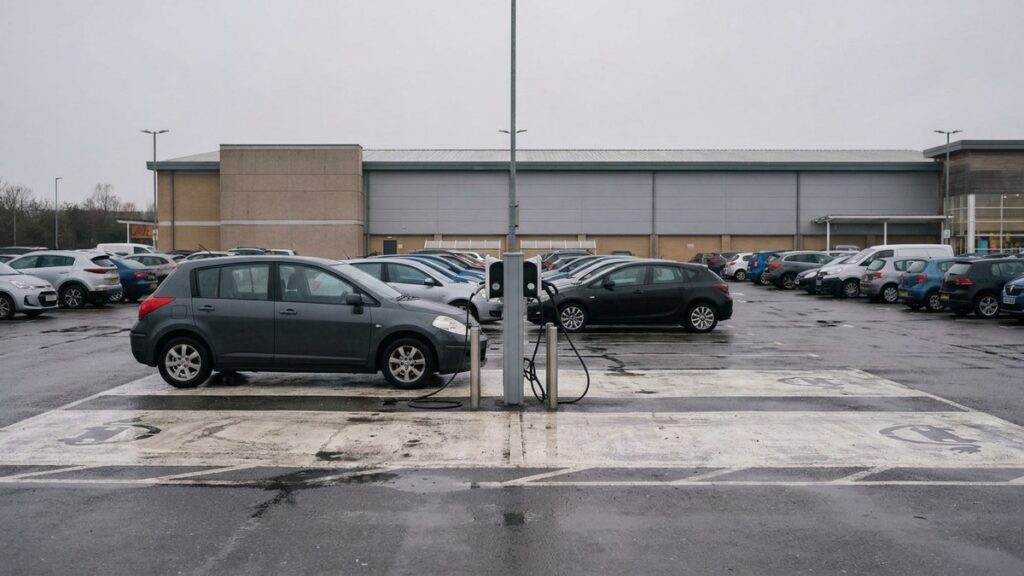
A free public charger can feel like a win, particularly when the alternative is a rapid charge that costs more per kWh than your home electricity. But is EV charging free in any meaningful, long-term sense? Sometimes, yes. More often, the charging session is free at the point of use while the cost sits somewhere else: in your shopping, your employment package, your parking fee, your electricity bill or the time spent waiting.
For a useful view of what your car actually costs to run, treat free charging as a real entry in your records, but do not let it disguise the wider picture. The right question is not whether a charger asks for a card. It is what you paid, directly or indirectly, to put those kilowatt-hours into the battery.
Is EV charging free at public chargers?
A small number of public chargers are genuinely free to use. You may find them at supermarkets, hotels, attractions, car parks, dealerships, workplaces or community sites. Usually, the host pays for the electricity because it wants to attract customers, support visitors or provide a staff benefit.
That does not mean every driver can turn up and fill the battery for nothing. Free units often have short stay limits, lower charging speeds, access restrictions or a requirement to be a customer. A destination charger supplying 7 kW for two hours can add a useful amount of range while you do something you needed to do anyway. It is less useful if you make a separate journey, wait around, then pay for parking.
Availability is another cost. A free charger may be occupied, out of service or limited to a particular app or membership. It can be sensible to use one when it fits your routine. Building your whole charging plan around it is different. The financial saving can disappear if it causes extra miles, lost time or an expensive back-up rapid charge later.
Some networks have offered promotional free charging with a new vehicle, a subscription, a property development or an energy tariff. Read the terms rather than recording the session as costless forever. There may be a kWh cap, an expiry date, a connection fee, an idle fee or a higher price once the allowance ends. A prepaid charging block is not free charging either. The cash has already left your account, even if the app shows a £0.00 session.
Free at the charger is not always free overall
The most common source of confusion is the difference between a zero-priced session and zero vehicle cost. An EV has costs beyond the energy delivered during a particular stop.
If a supermarket gives you 20 kWh while you shop, the electricity may indeed cost you nothing extra. But if you paid £3 for parking solely to access it, that parking fee belongs in the charging calculation. If you spent £15 more than planned because the offer encouraged a longer visit, that is a personal judgement call, not a clean charging cost. Keep the accounting honest: include charges that were necessary to obtain the energy, but do not invent costs for normal errands you would have made anyway.
Workplace charging needs similar care. It may be a valuable employee benefit, or it may be charged at a reduced rate. For business users and employers, the tax and VAT position can depend on who supplies the electricity, where charging happens and how the vehicle is used. The receipt, tariff evidence and mileage record matter. A claim based on a rough estimate is harder to defend than a log showing the date, location, kWh, amount paid and business miles.
There is also the cost of time. It is not always necessary to put a pound figure on every minute spent at a charger, but it is worth recognising the trade-off. A 50p-per-kWh rapid charge may be better value than a free 7 kW unit that forces an inconvenient detour and leaves you short of charge. Cheap and practical are not always the same thing.
Is home charging free if you have solar panels?
Home charging is rarely free. It is usually the cheapest and easiest option, especially on a well-chosen off-peak tariff, but your supplier still bills for imported electricity. If your tariff is 8p per kWh overnight and your car takes 50 kWh from the wall, the energy cost is about £4 before considering charging losses.
Solar adds nuance. Electricity generated by your own panels may feel free because there is no new payment at the moment you plug in. Yet it has an opportunity cost. If you could have exported that electricity for 15p per kWh, using it to charge the car means giving up that export payment. The honest cost of solar charging is often the export rate you forgo, rather than zero.
That does not make solar charging a bad choice. Far from it. Charging at home on a sunny day can be excellent value, particularly if the alternative is buying electricity at a higher rate or using a public rapid charger. It simply means that “free solar miles” are not marketing figures. They are a choice between two uses for the same energy.
Charging losses should be part of the calculation too. Your car battery does not receive every kWh drawn from the wall. The difference varies with the vehicle, charge speed, temperature and auxiliary systems. If your charger or vehicle reports grid energy, log that figure and the amount paid. It gives a more accurate running-cost record than relying only on the battery percentage added.
Record free charging properly
A £0 charging session should not be omitted from your logbook. It still consumed energy, added range and affected your average cost per mile. Leaving it out makes your energy use look lower than it was; recording an estimated retail electricity price makes it look higher. Neither shows what actually happened.
Record the location, date, kWh delivered, amount paid and any separate compulsory fee. For a genuinely free session, enter £0. Keep a photo of the screen or receipt where available, especially if the charge relates to business travel. For a prepaid package, record the purchase when you pay for it, then allocate the cost across the kWh you use so that your remaining balance and effective unit rate stay visible.
The same principle applies to home charging. Record the tariff rate actually in force, including VAT where relevant, rather than an annual average quoted by a supplier. If you charge across two tariff periods, split the session if it materially affects the number. Small inaccuracies accumulate quickly when you are trying to compare electric driving with a petrol baseline.
A practical cost-per-mile figure needs both sides of the equation: energy cost and miles driven. Energy-only cost per mile is useful for comparing charging choices. Running cost per mile is more realistic once you include tyres, servicing, insurance and other operating costs. Total cost of ownership goes further still, bringing in purchase price, finance and depreciation. A free public charge can improve one measure without transforming the others.
Amperlo is designed around this distinction: one phone-first record for paid, free and prepaid charging alongside mileage, receipts and vehicle costs. The result is an auditable number, not a headline based on an unusually cheap month or a handful of complimentary charges.
When free charging is worth using
Free charging is most valuable when it is already on your route, reliable, and gives you enough energy for the next part of your journey. It is particularly useful for drivers without home charging, for topping up during a regular weekly shop, or for reducing the cost of a longer trip while you stop anyway.
It is less compelling when the charger is slow, unreliable or difficult to access. Paying a modest amount for a dependable charge near home can be the cheaper decision once extra driving and disrupted plans are considered. Likewise, an apparently free charger with an idle fee can become expensive if you cannot return promptly.
The useful habit is to separate price from value. A £0.00 session is worth taking when it suits the journey, but it should sit in the same ledger as every other charge. Record the real kWh, retain the evidence and let the numbers show whether it lowered what your car actually costs to run.
