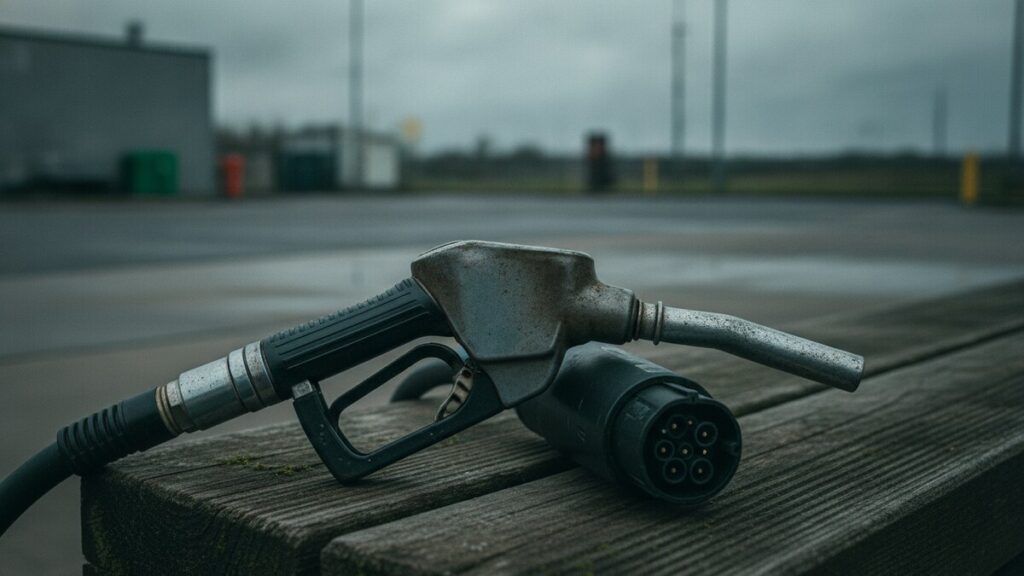
Every EV owner has been asked it: “so how much are you actually saving?” And most of the answers in circulation are built on sand — a manufacturer’s fuel economy figure nobody ever achieved, a pump price from two years ago, or simple wishful thinking. Amperlo’s savings-vs-petrol figure is built differently: it compares your logged, real-world EV costs against a petrol baseline you define, you can see, and you can defend.
The arithmetic, in the open
The baseline has exactly two inputs: a fuel price in pence per litre, and a fuel economy in miles per gallon. From those, Amperlo computes a petrol cost per mile:
petrol cost per mile = (pence per litre × 4.546) ÷ mpg
The 4.546 is simply the number of litres in an imperial gallon — it converts today’s per-litre pump price into a per-gallon one so it can meet an mpg figure on equal terms. At 145p a litre and 28mpg, that works out to about 23.5p per mile. Your EV’s actual energy cost per mile comes from your logged charges and mileage; the difference between the two, multiplied across your miles, is your saving. No black box, no “based on average driver” asterisk — two inputs you chose and arithmetic you can check on a napkin.
Whose mpg? Yours.
The mpg that belongs in that formula is not the one from a brochure. Official fuel-economy figures are produced on test cycles that flatter every car; real-world consumption is routinely well below them. Plug a brochure figure into your baseline and you systematically understate the petrol cost — which understates your saving, or overstates it if you pick the wrong brochure. Either way it is not evidence, and a sceptical colleague will smell it.
The honest choice is the car you would actually otherwise be driving, at the consumption it actually achieved. Amperlo’s own default grew out of exactly that: the app’s first baseline was the founder’s previous car — a petrol Mercedes SLK that returned 28mpg in real use — not a lab figure. Your equivalent might be the diesel estate you traded in, or the hatchback you would have bought instead. Set the baseline in Settings to that car’s real thirst and your savings figure inherits its credibility.
A baseline that moves with the pump
Petrol prices move, and a savings calculation frozen at one price rots quietly. Amperlo’s baseline is editable at any time — and, crucially, it is time-versioned. Each baseline carries the period it applies to, so when you update the pump price, the new figure applies from now on while your history keeps the baseline that was true at the time.
This matters more than it first appears. If updating the price rewrote history, every edit would silently restate two years of savings, and last year’s report would say something different every time you opened it. With versioned baselines, January’s miles are compared against January’s petrol price forever. The savings figure becomes a genuine historical record rather than a number that wobbles with the news.
The EV side of the ledger is real too
A baseline is only half of the comparison; the other half is what your EV actually costs, and Amperlo builds that from logged reality as well. Every charging session carries its source — home, public, a marina’s prepaid meter — and its true cost, including any discount your receipt showed, so the EV cost per mile the baseline is measured against is the blended rate you genuinely paid across all of them. Cheap overnight energy, an expensive motorway rapid charge, and everything between are all in the average. The savings figure on the Dashboard is therefore honest on both ends: real petrol arithmetic on one side, real charging history on the other.
Free electricity still counts — properly
Then there is the pleasant edge case: the charge that cost nothing. A top-up at a friend’s house, a freebie somewhere — Amperlo calls the source “gratis”, and it is handled with the same care as everything else, in two directions at once.
- Its cost is zero, and stays zero. Gratis kWh pull your average pence-per-kWh and cost-per-mile down, because they genuinely did.
- Its energy still counts. The kWh feed your efficiency figure (miles per kWh) exactly as paid energy does — discarding them would make the car look artificially efficient on the remaining, paid kWh.
And rather than letting free energy vanish from the story, Amperlo reports its “free kWh equivalent value” — what those donated electrons would have cost at your usual rates. Over a year of occasional free charging that becomes a real line in your savings, visible instead of silently absorbed. It is the same principle as the baseline itself: nothing hidden, nothing hand-waved, every number traceable to something that actually happened.
Why honesty wins the argument
It is tempting to tune a savings calculation for the biggest possible number — brochure-thirsty petrol car, peak pump price, electricity-only EV costs. The result impresses precisely nobody who checks it, and the whole comparison gets dismissed as advocacy. An honest baseline concedes ground up front: your real old car, its real consumption, the price that actually obtained in each period, free charging counted at its true value. The number that survives all that is smaller than the boast — and unlike the boast, it holds up when your most sceptical friend leans over your shoulder. That is the figure worth having, whether you are settling a pub argument or deciding if the switch was worth it.
Set yours in five minutes
Savings vs petrol is part of Amperlo’s free tier — one vehicle, full core tracking, no card. Sign up at amperlo.com, set the baseline in Settings to the petrol car you actually escaped, log your charges, and get a savings figure you can say out loud without crossing your fingers.

[…] with. It works because you chose both figures and can defend both figures. We have written about why an honest baseline beats a brochure mpg at more length elsewhere, and the short version is that a savings number inherits the credibility […]