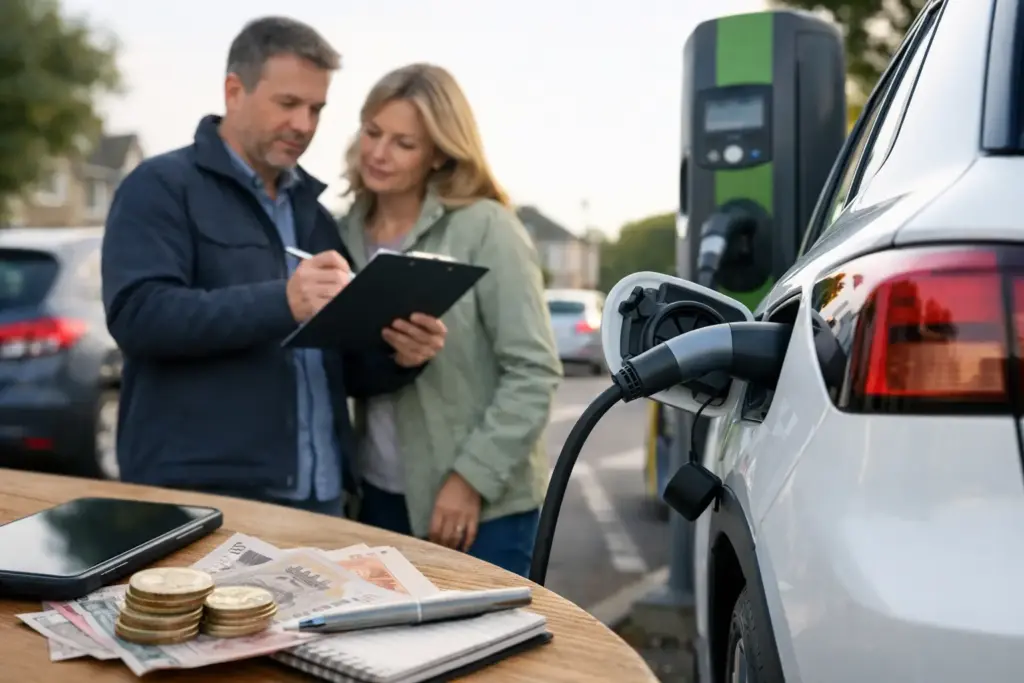
A marina pedestal is easy to treat as a small incidental expense: plug in, pay at reception, keep moving. But when shore power supports an EV charge, cabin systems, tools or a long stay, those small transactions can become an awkward gap in your vehicle records. A shore power cost tracker gives that energy a proper place in the ledger, so your cost-per-mile figure is based on what you actually paid, not a convenient estimate.
That matters most when the bill is not straightforward. Shore power may be charged by kWh, by day, through a prepaid card, as part of a berth fee, or as a mix of all four. The receipt may show VAT, may show only a top-up amount, or may not arrive until later. If you use the connection partly for your vehicle and partly for other equipment, the honest answer is not always one neat number. It is a record with enough detail to explain the number.
Why shore power needs its own cost record
Public charging networks usually provide a session total, a time and a kWh figure. Shore power is less consistent. One marina may issue a receipt for £20 of credit; another may invoice electricity after the fact; another may apply a standing charge to each connection. If you simply label every payment as “charging”, you can overstate what went into the car. If you ignore it altogether, you understate your real operating costs.
The first job is to separate the payment from the usage. Record the amount paid when you buy credit or receive an invoice. Then record the energy drawn, where a meter reading or pedestal display is available. Those two entries answer different questions: cash spent and electricity consumed.
This is especially useful for prepaid balances. A £30 top-up is not automatically a £30 charging cost on that day. It is a prepaid energy balance until the electricity has been used. Treating it that way prevents a single top-up from distorting one month’s running costs and makes the remaining credit visible rather than forgotten.
For self-employed drivers and small businesses, the distinction also supports cleaner records. A receipt, date, VAT amount, supplier and stated purpose are more useful than a bank transaction labelled only with a marina name. Whether VAT is recoverable depends on your circumstances and the evidence available, so the tracker should preserve the figures rather than make assumptions for you.
What to record at the connection
A good shore power cost tracker does not need a long form completed at a desk. It needs the details that disappear first when you are on a pontoon, carrying cables, or logging something one-handed in the dark.
Start with the date, location and payment amount. Add the tariff if it is known: pence per kWh, a daily connection fee, or a prepaid block. Photograph or attach the receipt while it is still in your hand. If the receipt shows VAT, save the net amount, VAT and gross total separately. That gives you a defensible record later, rather than a total you cannot reconcile.
Next, capture the meter reading or kWh used. If the pedestal only shows a start and finish reading, record both. If it provides no reading at all, say so. An estimate may still be necessary, but it should be marked as an estimate and based on a method you can explain, such as the vehicle’s reported energy added or a dedicated plug-in meter.
Finally, record what the power was for. This is where accuracy improves quickly. Electricity supplied to the EV should sit in the vehicle energy record. Electricity for shore-side equipment, accommodation or general boat use should not quietly inflate the car’s charging costs. Where one supply serves both, allocate only the portion you can reasonably support and keep a note of the basis used.
There is no prize for forcing false precision. A clear note saying “prepaid pedestal credit, EV share estimated from 18.4 kWh added” is more useful than pretending the whole payment belongs to the car.
Check that the supply is suitable for vehicle charging
A financial record does not make an electrical setup safe. Before using marina shore power to charge an EV, confirm that the outlet, cable, protection and site rules permit the intended load. A standard socket, a low-rated supply or a connection shared with essential equipment may not be appropriate for sustained charging.
If charging is permitted, record the actual charging power and time where possible. Lower-power charging can still be useful during an overnight stay, but it may involve more standing charges or a different effective rate than a rapid public charge. The cheapest pence-per-kWh figure is not automatically the cheapest practical option once connection fees, time and available energy are included.
Turn receipts and readings into a real rate
The useful figure is the effective cost per kWh, not just the advertised tariff. Calculate it by dividing the electricity cost attributable to the vehicle by the vehicle kWh received. Include unavoidable connection charges if they were necessary to get that electricity. Keep unrelated berth charges and non-vehicle consumption out of the calculation.
For example, imagine you buy £24 of prepaid electricity credit and the pedestal records 60 kWh used over several visits. During that period, 32 kWh goes to the EV, 20 kWh to other equipment and 8 kWh remains as unused credit. The vehicle energy cost is not £24. It is the vehicle’s share of the consumed credit: £12.80, before considering any separately stated fees. The unused balance remains an asset in your log, not a cost that has vanished.
If the same £24 included a £2 connection fee that was necessary for the EV session, you may choose to allocate that £2 to vehicle charging, producing £14.80 for 32 kWh, or 46.25p per kWh. That is a more honest operating figure than quoting the underlying energy tariff alone.
The right allocation depends on what happened. If the connection would have been paid for anyway for non-vehicle use, assigning all of it to the car would exaggerate its cost. This is why a note on the entry matters. It preserves the judgement behind the number.
See the impact beyond a single charge
One shore-power entry is useful. A consistent record becomes valuable when it joins home charging, public sessions, maintenance, insurance, tyres and mileage. Then you can see energy-only cost per mile alongside the wider running cost and total cost of ownership.
That wider view prevents selective comparisons. An EV may receive low-cost electricity at a marina one month and expensive motorway charging the next. Neither figure is the whole story. A blended rate across every recorded source shows what your car actually costs to run across the way you really use it.
A petrol comparison should be equally specific. Set a petrol baseline using a current fuel price and realistic mpg, then compare the recorded EV energy cost against that baseline for the miles driven. It is not a manufacturer saving claim and it should not assume every EV mile costs the same. It is your car, your charging pattern and your numbers.
For business use, preserve the mileage linked to the shore-power period or charge where practical. The charge itself may not map perfectly to one journey, particularly after overnight charging, but the growing record will still show energy consumed against miles covered. That is far more useful for budgeting and reporting than trying to reconstruct a year from card statements.
Build a record you can trust later
The simple habit is to log the payment when it happens, add the usage once the meter is known, and keep the receipt attached. Do not wait for the end of the month. By then, a £15 marina top-up can look identical to a meal, a berth charge or a forgotten cash expense.
Amperlo is designed for precisely these awkward, real-world entries: recording a charge or prepaid block from a mobile phone, keeping receipts and VAT splits together, and folding the eventual energy cost into a clear cost-per-mile record. The aim is not to make shore power look cheaper or dearer than it was. It is to stop it becoming an invisible cost.
The next time you connect at a marina, take the extra minute to record the tariff, payment and meter reading. Future you will have a figure that can be checked, explained and used – not marketing figures, just the evidence of what the car actually cost to run.
