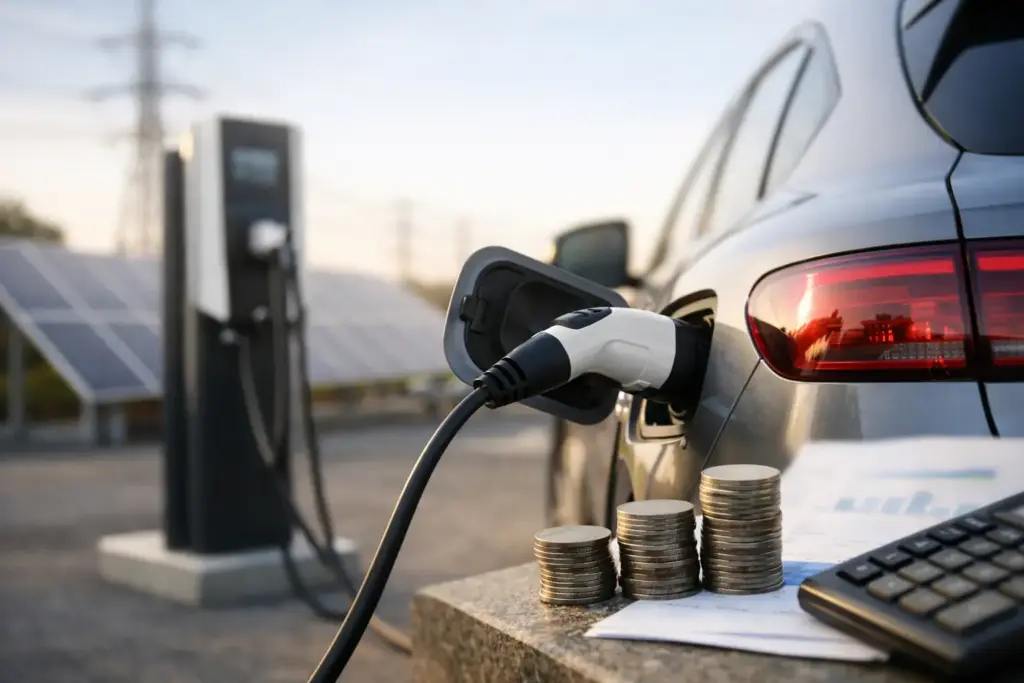
A 7p/kWh overnight rate and a 79p/kWh rapid charge can power the same car for dramatically different money. That is why charging tariffs deserve more attention than the headline efficiency figure on a brochure. Your EV does not have one running cost. It has a changing mix of prices, taxes, fees and charging losses that only becomes useful when it is recorded properly.
For a driver trying to budget, reclaim business costs or compare an EV with a petrol car, the question is not whether electricity is cheaper in theory. It is what your car actually costs to run, charge by charge and mile by mile.
Why charging tariffs change the real cost of driving
A tariff is more than a price per kWh. At home, it may include a low overnight unit rate, a higher daytime rate and a standing charge. On the public network, it may involve a flat rate, a time-based rate, a connection fee, an idle fee or a subscription that changes the advertised price. Some workplace and destination chargers are free to use, but the energy still has a value if you are calculating the genuine cost of travel.
The arithmetic is straightforward, but the inputs are often fragmented. A home supplier app shows one figure, a charging-network receipt another, and a prepaid charging balance may obscure the cost of an individual session. If you rely on memory or a monthly bank statement, the result will usually be an estimate rather than a financial record.
That matters because a small change in energy price has a large effect over a year. An EV averaging 3.5 miles per kWh costs roughly 2p per mile for energy at 7p/kWh, before losses. At 70p/kWh, it is about 20p per mile. Both figures can be true for the same vehicle on the same route. Neither is a useful ownership figure without knowing how often each tariff applies.
The unit rate is only the starting point
For every charge, record the kWh added, the amount paid and where the charge happened. This gives you an actual pence-per-kWh figure, rather than assuming that the charger price and the energy reaching the battery were identical.
Charging losses complicate the picture, particularly at home. Your electricity meter measures energy drawn from the supply, while your vehicle may report a lower amount delivered to the battery. Neither number is wrong. For household spending, use the meter-side energy where it is available because that is what you paid for. For battery performance, the vehicle figure remains useful. Keeping both, where practical, stops efficiency data from being confused with the bill.
Session fees and overstay charges should sit alongside the energy cost, not disappear into a general category. A £1 connection fee on a small top-up can materially alter the effective rate. So can a £10 idle fee after a delayed return to the car park. These are not charging costs in the narrow engineering sense, but they are real costs of operating the car.
The charging tariffs worth tracking separately
You do not need a spreadsheet with dozens of tariff labels. You do need enough separation to see what is driving your average. For most UK EV owners, four charging sources tell the useful story:
- Home charging on an off-peak or time-of-use tariff.
- Home charging at the standard or peak household rate.
- Public charging, including rapid and ultra-rapid sessions.
- Workplace, destination or marina shore-power charging, whether paid, subsidised or free.
A fifth category is worth adding when you buy charging credit in advance. Prepaid blocks can make a charging session look free after the initial purchase, which gives a misleading cost-per-mile figure. Instead, record the upfront payment as a balance, then allocate the cost as the kWh are used. You can see the remaining credit, the effective rate and whether the offer was genuinely good value.
Subscriptions need the same treatment. If a £10 monthly membership saves 10p/kWh on public charging, it only pays for itself once you use enough energy. Divide the monthly fee by the discounted kWh to find the break-even point. Below that point, the cheaper advertised unit rate may cost more overall.
Standing charges and solar need an honest rule
A standing charge is normally payable whether or not you own an EV. For that reason, many private drivers exclude it from the car’s energy cost and track it as a household bill. That is reasonable, provided you are consistent.
The answer can differ if you switched energy supplier or tariff specifically to obtain cheap overnight charging, or if a business needs a full allocation of vehicle-related electricity. In that case, record the incremental cost created by the choice, and keep a note explaining the method. The aim is not to force one universal answer. It is to produce an auditable answer you can defend later.
Solar charging creates a similar choice. Calling it free may be convenient, but it can hide the value of electricity that could otherwise have been used in the home or exported. For simple household budgeting, you may log the cash cost as zero and label it clearly. For total cost analysis, assign a chosen opportunity cost and apply it consistently. What matters is not making a promotional claim about free miles when the underlying assumption has changed.
VAT can alter the comparison
Domestic electricity is generally charged at 5% VAT, while public EV charging is typically charged at 20% VAT. That difference is one reason a public charging receipt can look disproportionately expensive even before considering the higher unit price.
For private owners, the gross amount paid is usually the number that matters to the household budget. For a self-employed driver or small business, the net amount and VAT element may matter separately. Keep the receipt, supplier name, date, location, kWh and total wherever possible. A card transaction alone proves payment, not necessarily the nature of the expense or the tax treatment.
Do not assume every receipt supports the same reclaim position. The correct treatment depends on who paid, where the electricity was used, the vehicle’s business use and the wider tax position. Good records do not replace professional advice, but they give an accountant something far better than reconstructed guesses at year end.
Turn tariff data into a useful cost-per-mile figure
Energy cost per mile is best calculated from the money actually spent on charging divided by the miles driven over the same period. If you charged 400 kWh at a blended cost of £100 and drove 1,400 miles, your energy cost was about 7.1p per mile. This is more reliable than multiplying a claimed battery range by a single tariff.
The period matters. A week with a motorway holiday and several rapid charges may look expensive. A month spent charging overnight at home may look exceptionally cheap. Neither is wrong. Over several months, the blended figure starts to show your normal driving pattern, while individual sessions reveal the costly exceptions.
Keep three views separate. Energy-only cost per mile answers what electricity cost. Running cost per mile adds tyres, servicing, insurance, parking and other operating expenses. Total cost of ownership can also include finance, depreciation and vehicle purchase costs. Mixing them creates a reassuringly low or alarming figure, depending on what happened to be omitted.
The same discipline applies to petrol comparisons. Use your own configured petrol price and realistic mpg baseline, then compare it with actual EV energy spending. A national average, a manufacturer range estimate or a single cheap overnight tariff is not your saving. It is a marketing figure until it matches your vehicle, route and receipts.
Make the record easy enough to maintain
The best tariff system is the one you will use one-handed, in the dark, at the end of a wet charging stop. Capture the charge while the receipt is available: date, cost, kWh, tariff or network, and a photo of the receipt if needed. Add mileage regularly rather than trying to rebuild it from memory months later.
A phone-first log such as Amperlo can keep home, public and prepaid charging in one operational ledger, alongside mileage and vehicle expenses. The value is not more admin. It is being able to see a blended rate, a VAT split and an honest cost per mile without stitching together supplier apps, emails and bank transactions.
If your charging pattern changes, let the data show it. A new tariff, a longer commute, more public charging or a move to a different vehicle can all shift the numbers quickly. Record the real rate, keep the receipt, and give your future self a figure that explains what happened rather than merely claiming that electric driving should have been cheap.
