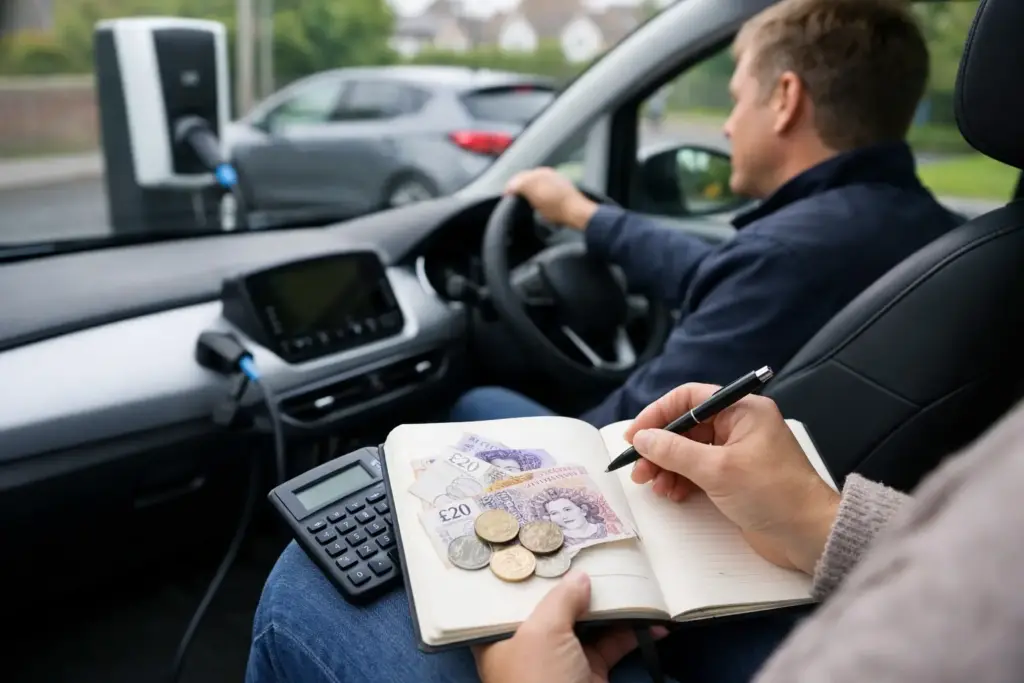
A new charging receipt says £18.47. Your home energy bill has gone up. The tyres cost more than expected. Yet the dashboard still claims impressive efficiency. An EV logbook joins up those separate facts, so you can see what your car actually costs to run – not marketing figures, not a guess based on one cheap overnight charge.
For most drivers, the difficult part is not finding a cost-per-mile calculator. It is collecting the right information before it disappears into a charging app, a bank feed, a glovebox receipt or a half-remembered conversation at the garage. A useful logbook makes that record practical enough to maintain, one-handed and in the dark, while still detailed enough to stand up to a proper financial review.
An EV logbook is more than a charging diary
Recording every public charge is a sensible start, but it gives only part of the picture. Public rapid charging can be expensive, home charging is affected by your tariff, and some energy is bought in advance through subscriptions or prepaid blocks. Looking at any one of those in isolation can make an EV seem unusually cheap or unexpectedly costly.
A proper EV logbook records the transaction behind the charge as well as the electricity delivered. That means the date, supplier, kWh, amount paid and, where available, VAT. It also needs to handle the awkward real-world cases: a charge session paid for from an existing credit balance, a receipt that arrives later, or a monthly plan that covers only part of your charging.
Mileage is the other half of the calculation. Without it, a monthly charging total is just a number. With an opening and closing odometer reading, you can see whether a £95 month was expensive because energy prices rose, because you drove further, or because you used more rapid chargers than usual.
What to put in your EV logbook
The best record is complete enough to answer financial questions, without becoming a second job. Start with every charging event and mileage reading, then add the ownership costs that tend to get ignored when people compare electric and petrol motoring.
Charging and energy costs
For a home charge, record the date, kWh added, tariff rate and total energy cost. If your tariff changes by time of use, use the rate that actually applied, rather than a blended household average. A cheap overnight tariff may make up most of your charging, but a few evening top-ups at a higher rate can still move the true average.
For public charging, retain the receipt whenever possible. Record the network, location if it helps you review usage, kWh, price per kWh and the final amount. Parking, connection and overstay charges should be recorded separately where they are separately charged. They are costs of using the vehicle, but they can distort the price you paid for electricity if they are folded into the energy rate.
Prepaid credit deserves its own entry. If you buy a £50 charging block, do not count the full £50 again every time you use it. Log the purchase when the money leaves your account, then track the remaining balance and the energy drawn from it. This avoids the common mistake of reporting a low-cost month while quietly ignoring money paid upfront in the previous one.
Mileage, servicing and the costs beyond the cable
Mileage should be logged regularly, not only at MOT time. A weekly reading is often enough for a private owner; drivers using a car for work may prefer to capture business and personal miles as they happen. The key is consistency, especially if you want to calculate a defensible business-use proportion.
Then record the wider running costs: servicing, repairs, tyres, insurance, breakdown cover, vehicle excise duty where applicable, parking and car washes if you want a fully rounded operating view. Finance, lease payments and depreciation belong in a total-cost-of-ownership view, but should not be mixed into an energy-only cost-per-mile figure.
That distinction matters. A car can be very economical on electricity while still being expensive to own because of finance charges, insurance or a sharp fall in value. Equally, a tyre replacement can make one month look alarming even though it is a periodic cost spread across many thousands of miles.
The figures that make the record useful
An EV logbook should turn raw entries into several views, because there is no single answer to the question, “What does my car cost per mile?”
The first is energy-only cost per mile: charging spend divided by miles driven. This is the clearest measure of the cost of propelling the car and is useful for comparing home and public charging habits.
The second is running-cost per mile. This adds routine operating costs such as tyres, insurance, servicing and repairs. It is a more honest budgeting figure, particularly for drivers whose public charging use varies from month to month.
The third is total cost of ownership per mile. This can include finance, depreciation and other ownership costs. It is the most complete number, but it needs context. Over a short period it can swing wildly because of an insurance renewal, a deposit or a one-off repair. Review it over a longer period before drawing conclusions.
A comparison with a petrol car can be useful too, but only when the baseline is yours. Set a realistic petrol price and mpg figure for the vehicle you would otherwise drive. A comparison based on an optimistic official mpg claim is no better than an optimistic EV claim. Your actual driving pattern, fuel price and charging mix determine the saving.
Keep VAT and receipts separate from assumptions
For self-employed drivers and small businesses, the record needs to do more than show a monthly total. You may need to identify VAT on individual charging receipts, retain evidence of the transaction and separate business travel from private mileage. An app screenshot showing a charge total may be helpful, but it is not always the same as a receipt with the relevant VAT details.
The practical approach is to save the receipt at the time of purchase and attach it to the relevant entry. Photograph paper receipts before they fade. Add a short note when something is unusual, such as workplace charging, reimbursement by a client or a home-energy estimate. A clear note now is better than trying to reconstruct the transaction months later.
VAT treatment and expense claims depend on your circumstances, the vehicle arrangement and the evidence available. An accurate logbook gives your accountant a cleaner record; it does not replace professional advice. That is a worthwhile boundary. Financial reporting should show what happened, not quietly make assumptions that cannot be supported later.
Build a habit that survives real driving
The ideal system is not the one with the most fields. It is the one you will still use after a wet motorway stop, a school run and a late-night charge at home. Log the essentials immediately: amount paid, kWh and mileage. Add a photo of the receipt. Fill in optional detail later if needed.
Set a regular review point, perhaps at the end of each month. Check whether charging spend matches your expectation, whether prepaid balances are falling faster than expected and whether the mileage record has gaps. This is also the moment to spot patterns: too many high-cost rapid charges, a tariff that no longer suits your routine, or tyre wear that is becoming a meaningful part of the budget.
Amperlo is built around this kind of operational record: charge, mileage, receipt and vehicle-cost data in one phone-first ledger, with figures that can be traced back to the entry that created them.
The value of an EV logbook is not a flattering headline number. It is the quiet confidence of knowing, before the next renewal, repair or long journey, where your money is going and which decisions can genuinely improve it.
