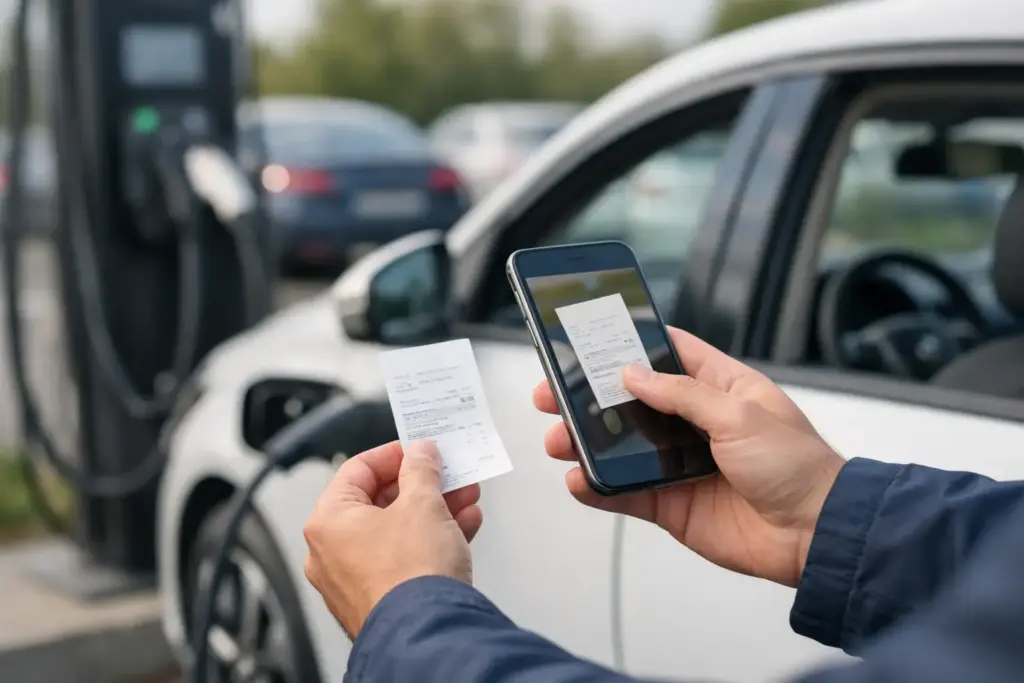
A charging receipt is easy to ignore when you are unplugging in rain, late for work, or balancing a mobile phone and cable one-handed in the dark. But if you do not scan EV charging receipts while the transaction is still fresh, the real cost of running your car quickly becomes a guess. A bank line saying £18.42 is evidence of payment, not a usable record of what you bought.
For an honest EV cost picture, you need the amount, energy, rate, date, location and VAT treatment where available. That is how a collection of charging sessions becomes a financial record you can actually use – for budgeting, expense claims, or working out whether your car is cheaper than the petrol alternative in your own circumstances.
Why scanning EV charging receipts changes the numbers
Public charging costs are rarely as simple as price per kWh multiplied by energy delivered. A receipt may include a connection fee, a minimum spend, parking, an idle fee, or a discounted rate tied to a membership. Some networks show the tariff clearly; others provide a transaction total and little else. If you only record the total from your bank account, your cost-per-mile figure loses useful detail.
A scanned receipt preserves the source document before it disappears from an app or email inbox. It also gives you a way to check a manually entered charge later. This matters when figures look odd: perhaps a rapid charge cost more because you paid a peak tariff, or perhaps the session was interrupted and the kWh figure is lower than expected.
For self-employed drivers and small businesses, the receipt is also part of the audit trail. A payment notification does not normally identify VAT, energy quantity or the charging provider. Those details can determine whether a cost is suitable for an expense record or VAT reclaim assessment. Your own tax adviser should guide the treatment, but keeping the original evidence gives them something practical to work with.
What a useful charging receipt should capture
The best scan is not necessarily a perfect photograph of every line of small print. It is a clear record that lets you verify the charge and understand its cost later. Start with the transaction date, supplier, total paid and the vehicle or charging session it relates to.
Then capture the energy delivered in kWh, the unit rate if shown, and any separate fees. These fields make it possible to distinguish a 45p per kWh session from a charge that looks similar in total but includes a £1 connection fee or 20 minutes of parking. That distinction affects your blended energy rate and your running-cost analysis.
Where the document shows VAT, retain the VAT amount and rate as well. Not every charge will present it in the same format, and not every driver will be able to reclaim it. The point is not to force a tax outcome. It is to keep the underlying figures accurate, rather than trying to recreate them months later from memory.
Location can be valuable too. A receipt from a motorway rapid charger tells a different story from one at a supermarket, office car park or destination charger. Over time, location data can reveal where convenience is costing you most, without pretending that every expensive charge was avoidable.
Scan the receipt before the evidence vanishes
The most reliable routine is simple: scan or photograph the receipt as soon as you receive it, then check the key details while the charging session is still on screen. Paper slips fade. Provider apps can be logged out, replaced or difficult to search. Emails get buried beneath booking confirmations and newsletters.
Make sure the whole receipt is visible, with no glare across the total or VAT section. If it is a long thermal receipt, take two clear images with a small overlap rather than forcing tiny text into one blurred photo. For a digital receipt, save the original document or capture the final transaction screen where the essential fields are visible.
Receipt scanning software can read much of the text automatically, but it should not be treated as infallible. Decimal points, VAT values and kWh figures are exactly the details that optical character recognition can misread. A £6.80 transaction becoming £68.00 will make a nonsense of your monthly costs. Check the numbers before accepting them, especially for high-value rapid charges.
Match the receipt to the charge, not just the payment
A single payment does not always equal a single charge. This is most obvious with prepaid charging balances. You might add £50 to a network wallet in January, then use that credit across several sessions in February and March. Recording the full £50 as January energy spend makes that month look artificially expensive and later charges appear free.
Instead, keep the top-up as a prepaid balance and reduce it as each charging session uses credit. The useful figure is the burn rate: how much of that balance has actually been consumed, and what remains. The same principle applies to subscriptions, workplace schemes and charging cards where the payment date differs from the date electricity is used.
Conversely, a charging session can appear on your card days after you plugged in. Match it by provider, amount, session date and kWh, rather than assuming the banking date tells the full story. This is a small discipline that prevents duplicate entries and keeps monthly reporting credible.
Do not force home charging into a receipt-shaped record
Home charging is often your cheapest energy, but it usually does not produce an individual receipt. Your electricity bill covers household consumption, standing charges and possibly several tariff periods. Treating the entire bill as vehicle energy is no more accurate than ignoring home charging altogether.
Use the kWh delivered to the car where you have it from a smart charger, vehicle log or meter reading. Then apply the relevant electricity rate for the time of use. If you charge on an overnight tariff, use that overnight rate rather than your daytime unit price. If your tariff changes, record the new rate from the change date.
There is a trade-off here. A highly detailed time-of-use calculation is useful for a driver who charges frequently and wants precise costs. For occasional home charging, a sensible documented average may be enough. The right method is the one you can maintain and explain, not the one with the most impressive spreadsheet.
Turn receipt data into what your car actually costs to run
Once receipts and charging logs are together, you can measure more than a monthly total. Divide energy cost by miles travelled and you have an energy cost per mile. Add servicing, tyres, insurance, vehicle tax where relevant, finance and depreciation, and you can build a running-cost or total-cost-of-ownership view.
Keep these views separate. Energy-only cost answers whether charging itself is cheap or expensive. Running cost includes the expenses required to keep the car on the road. Total ownership cost is broader again. Combining everything into one number too early can hide the reason a month was costly – perhaps public rapid charging rose during a long trip, while tyre replacement was the real hit to overall spending.
A petrol comparison can be useful, provided it uses your chosen fuel price and realistic mpg baseline. It should not be a manufacturer claim or a generic savings promise. Your mileage, charging mix and tariff determine the result. A driver with off-peak home charging may see a very different outcome from someone relying on public rapid chargers without home access.
A practical monthly check
At month end, review charges that have no receipt, receipts that have no matching charge, and prepaid balances that do not reconcile. Correct obvious errors while the month is recent. Then look for patterns rather than judging one costly session in isolation.
You may find that a particular route needs a better charging plan, that a subscription no longer pays for itself, or that your real home rate is doing more work than the headline public-charging price suggests. Amperlo is built around this kind of mobile-first record: capture the evidence, check the figures, and let the ledger show the result.
The goal is not to make every charge cheap. Some journeys require the fast, convenient option. The goal is to retain enough evidence that the cost is real, explainable and useful when you next ask what your car actually costs to run.
