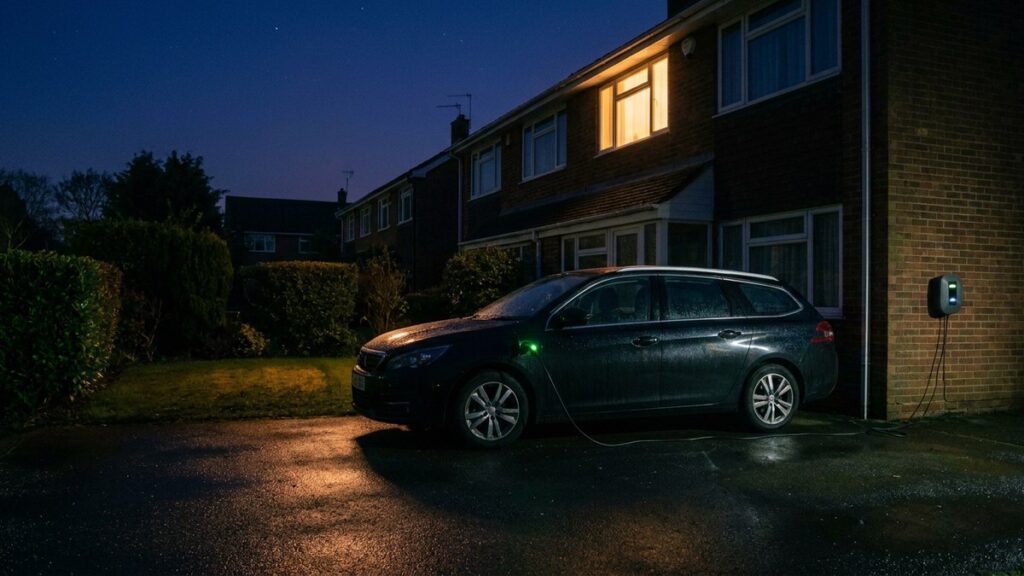
Here’s a question that sounds trivial and isn’t: if you plug your car in at 1am after a long evening’s driving, what day did that charge happen on?
The calendar says it happened today. Common sense says it belongs to yesterday — it’s the end of yesterday’s driving, paid for by yesterday’s decisions, part of yesterday’s story. Almost every tracking tool sides with the calendar, and their daily numbers quietly suffer for it. Amperlo sides with common sense, and this post explains the small rule that makes it work.
The rule
Any entry timestamped before 04:00 is attributed to the previous calendar date. Amperlo records both values — the exact clock time you logged it, and a session date that says which day the entry belongs to. A charge finishing at 1:20am on Saturday is recorded at 1:20am on Saturday, but counts as Friday’s charge. The same rule applies uniformly to charging sessions, odometer readings and meter readings, so all three kinds of record agree about what “a day” means.
Why 4am? Because it’s the quietest hour of the human day — late enough that an evening out, a night drive home, or a lock-up-and-plug-in at 2am are all still clearly “tonight”, and early enough that a genuinely early start belongs to the new morning. If your life runs on a different clock — shift work, say — the cutoff hour is configurable, but 4am is the default because it’s where almost everyone’s days actually break.
What goes wrong without it
Split days at midnight and a familiar pattern of small lies creeps into your records.
Take a real sort of evening: you drive 90 miles, get home late, plug in at half past midnight, and note the odometer while you’re at it. Under midnight-splitting, today’s log shows 90 miles driven and no charging cost; tomorrow’s shows a hefty charge against a day the car barely moved. Neither day is right. Today looks implausibly cheap per mile, tomorrow looks absurd, and if you do this even once a week — most of us who drive in the evening do — your daily record becomes a sawtooth of alternating fictions.
The averages eventually wash out, which is exactly why the problem survives unnoticed. But anything that reads your data day by day inherits the noise: daily cost summaries, mileage deltas between consecutive readings, any answer to “what did Friday actually cost?”. And late-night entries are systematically biased — they’re not a random scattering across the small hours, they’re overwhelmingly the tail end of the previous evening. A midnight split doesn’t add noise so much as consistently file the end of each day under the wrong heading.
Where you feel the difference
- Daily deltas make sense. An odometer reading noted at 1am groups with the day you actually drove those miles, so the miles and the driving land on the same date instead of the miles appearing on a day the car sat still.
- Costs sit next to their causes. The charge that refilled Friday’s driving is booked to Friday. When you look back at an expensive day, the day contains its own explanation.
- Prepaid meters read cleanly. If you’re on a countdown meter — shore power at a marina, for instance — usage is the difference between consecutive readings. A late-night reading attributed to the wrong day would misplace a whole night’s consumption; the 4am rule keeps each night’s usage on the night it happened.
- Exports carry both truths. The odometer CSV export includes both the exact recorded-at timestamp and the session date, so a spreadsheet, or your accountant, can group by human days without redoing the logic — while the audit trail of literal clock times stays intact.
Designed for the way nights actually end
The rule pairs with a convenience you’ll meet in the app. Quick Log — the one-tap entry screen built for logging with one hand in the dark — includes a “marina overnight” shortcut that pre-fills the source and sets the date to yesterday, because that’s what an overnight plug-in almost always is. The 4am rule is the same understanding applied automatically: the app already knows your 1am entry is the end of tonight, not the start of tomorrow, without you having to think about it.
And because a date-attribution rule is worthless if it wobbles at the edges, the boundaries are pinned down by automated tests — 23:59, midnight, 3:59, 4:00, 4:01 — so an entry either side of the cutoff always lands exactly where the rule says it should. Unglamorous, but this is bookkeeping: the edges are the whole point.
Small rule, honest numbers
Most of what makes tracking trustworthy isn’t clever features — it’s dozens of small decisions about what the data should mean, made once, applied everywhere, and tested. Store costs with and without VAT rather than deriving one from the other. Count free charging’s kWh towards efficiency even though it cost nothing. And end the day when people actually stop driving, not when the calendar flips.
You’d probably never have asked for the 4am rule by name. But it’s the difference between daily numbers you trust at a glance and daily numbers you’ve learned to squint at — and you get it without configuring anything at all.
If you’d like a logbook that understands what a day is, amperlo.com is free for one vehicle — plug in at 1am with a clear conscience.
